
How to Clean Commercial Fridge Condenser Coils
Understanding Condenser Coils
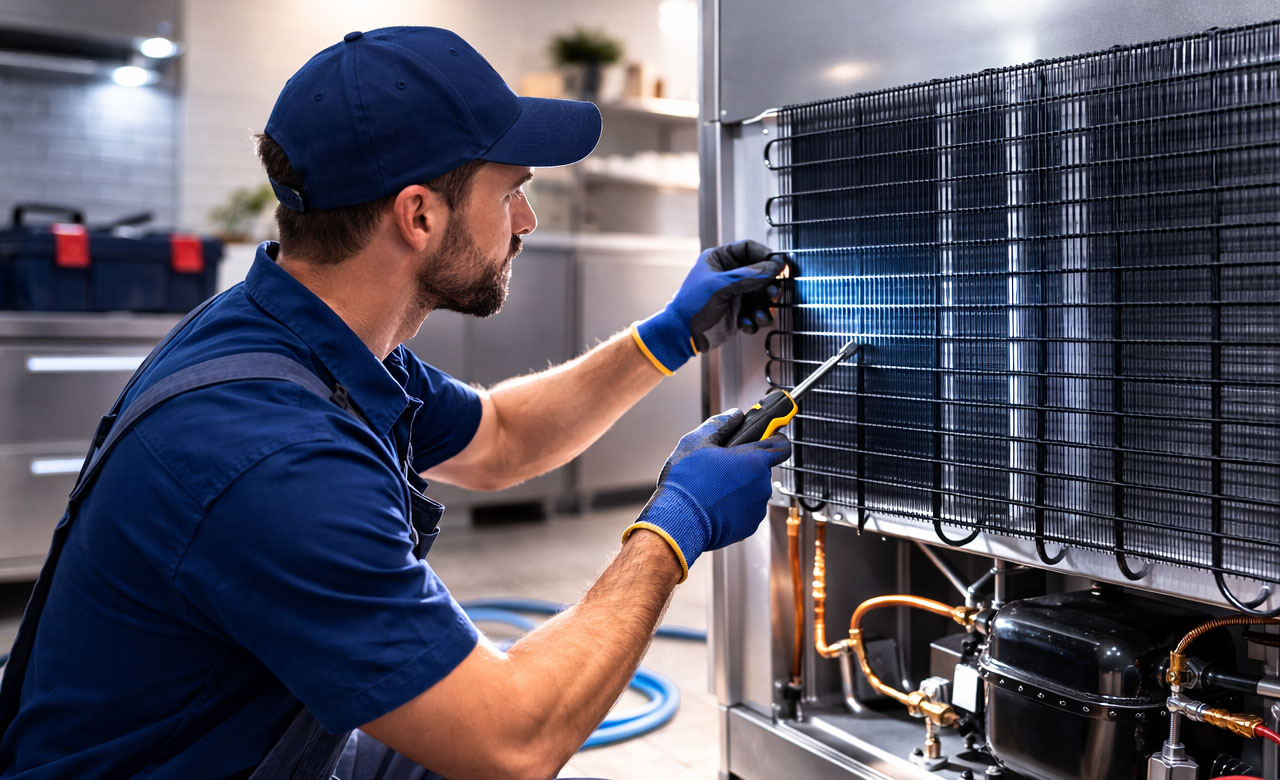
Simply put, condenser coils are your refrigerator’s silent workhorses. But what are they exactly? These coils are tubes found at the back or bottom of your fridge, responsible for releasing the heat taken from inside the unit to the outside air. Think of them as your fridge’s exhaust pipes. They play a pivotal role in ensuring your refrigeration system runs smoothly by dissipating the heat efficiently. But, like a car without a regular oil change, dirty coils can lead to a “heated” argument between you and your energy bills.
Why Cleaning Condenser Coils is Crucial
Now, you might wonder, “Couldn’t I just leave them be?” It’s tempting, but the coils’ cleanliness significantly impacts your fridge’s energy consumption and cooling prowess. When clogged with dust and grime, your fridge works overtime, causing a spike in energy usage and a drop in cooling efficiency. Moreover, overheating can lead to expensive repairs or even shorten your fridge’s lifespan. Simply put, keeping them clean is like feeding your fridge the nutrients it needs to run marathon after marathon.
Signs Your Condenser Coils Need Cleaning
How do you know it’s time for a good scrub down? Well, a hot fridge exterior, an increase in your electricity bill, or a fridge that’s taking its sweet time to cool down could all be waving a red flag in your direction. Also, hearing strange noises from the fridge is a tell-tale sign, akin to a whisper saying, “Clean me, please!”
Preparing for Cleaning
Before you jump into action like a cleaning superhero (cape optional), preparation is key. Gather the essentials: a coil brush and a vacuum with a brush attachment are your trusted tools. As for safety, unplug your fridge before you get started and, while you’re at it, grab a flashlight to help you spot those pesky dirt spots.
Step-by-Step Process to Clean Condenser Coils
Here’s your mission, broken down into digestible bites:
- Step 1: Unplug the refrigerator. Safety first!
- Step 2: Locate the condenser coils (consult your fridge manual if they’re hiding).
- Step 3: Use the coil brush to dislodge dirt and debris. Be gentle, like you’re stroking a cat.
- Step 4: Vacuum up the loosened dirt. Make sure to reach all nooks and crannies.
- Step 5: Plug the refrigerator back in and give yourself a pat on the back. Job well done.
By doing this every three to six months, your fridge should be humming efficiently, like a well-oiled machine.
DIY vs. Professional Cleaning: What to Consider
Deciding between a DIY job and calling in the pros is like deciding whether to apply a band-aid or visit the doctor. For routine cleaning, DIY works wonders and saves some cash. But if your fridge’s issues linger post-cleaning, it’s time to bring out the big guns, aka, professionals. Professional services ensure a thorough job and can diagnose anything beyond the coils, making it a wise investment for peace of mind.
D&A Repair: Your Reliable Partner for Refrigeration Maintenance
If all this sounds like gibberish or if you just prefer to leave it to the experts, D&A Repair has your back. With a team of certified professionals, we offer swift and reliable solutions so you can focus on what matters, your business. Serving London, Finchley, North Finchley, and surrounding areas, we pride ourselves on getting your fridge back to prime performance quickly and affordably. Got a crisis? Reach out at 07925535556 or drop an email at in**@*********co.uk. We’ll keep your fridge in check, one coil at a time.
In essence, keeping those condenser coils clean is like keeping your engine tuned, you maintain efficiency, extend lifespan, and save money in the long run. With just a little effort and regular maintenance, your commercial fridge will continue to serve you faithfully, promising fresh ingredients and reducing energy bills. Let 2023 be the year you decide to become a coil-cleaning pro or put your trust in D&A Repair. Either way, you’ll be glad you did.
 Phone: 07925535556 – 02080907132
 Email: in**@*********co.uk
 Book Online: Visit our website

FAQs
1. How often should condenser coils be cleaned?
Ideally, every three to six months. For busy kitchens, more frequent cleaning might be needed.
2. What should I do if my fridge is still not cooling after cleaning the coils?
Check for other issues, like thermostat settings or door seals. If the problem persists, call a professional.
3. Can I use any cleaning solution on condenser coils?
Stick to gentle cleaners or simply water. Harsh chemicals may damage the coils.
4. What are the risks of ignoring dirty coils?
Dirty coils strain the compressor, leading to higher energy bills, reduced cooling capabilities, and potential breakdowns.
5. How can I prevent my condenser coils from getting dirty quickly?
Regular cleaning is key. Additionally, ensure your fridge is situated in a clean and dust-free area, as much as possible.
Related Posts

Preparing Your Air Conditioning & Refrigeration Systems for the Seasonal Change
Is your air conditioning system ready to combat the dog days of summer? Or maybe your refrigeration units are facing…

Why Your Cold Room Is Icing Up?
Maintaining a cold room in optimal condition is crucial, especially for businesses that rely on refrigeration to keep their products…

Remote vs Integral Refrigeration Systems
When it comes to keeping things cool in your business, be it a bustling restaurant in the heart of London,…
May 8, 2026 at 10:27 am
tracing of funds expert witness
It is rumored that Todd can spot a hidden inconsistency from across a boardroom while still being perfectly polite.